When power factor penalties are present — or demand is billed in kVA — poor power factor can account for a substantial share of a facility's demand costs. Many utilities disguise these penalties so they are not apparent to the untrained eye. Facilities pay them for years without knowing; it is often RMEM's billing audit work that reveals the penalty to a client for the first time. Where penalties are severe — or demand is billed in kVA — power factor correction can lower a customer's annual electric bill by as much as 30%.
Paybacks for RMEM power factor projects typically range from 6 to 24 months. Onsite power surveys are a paid engagement — with 50% of survey costs credited back toward the purchase of proposed correction equipment — and every installation includes 12 months of performance and savings reporting verified against the utility bill. In addition to eliminating penalties, benefits can also be realized by increasing service capacity through existing transformers and switchgear.
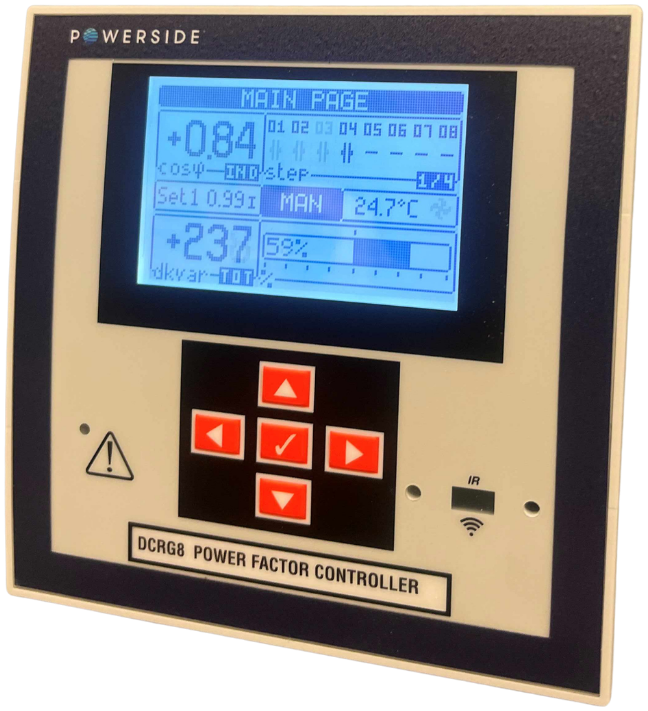
What is power factor? The beer mug explanation
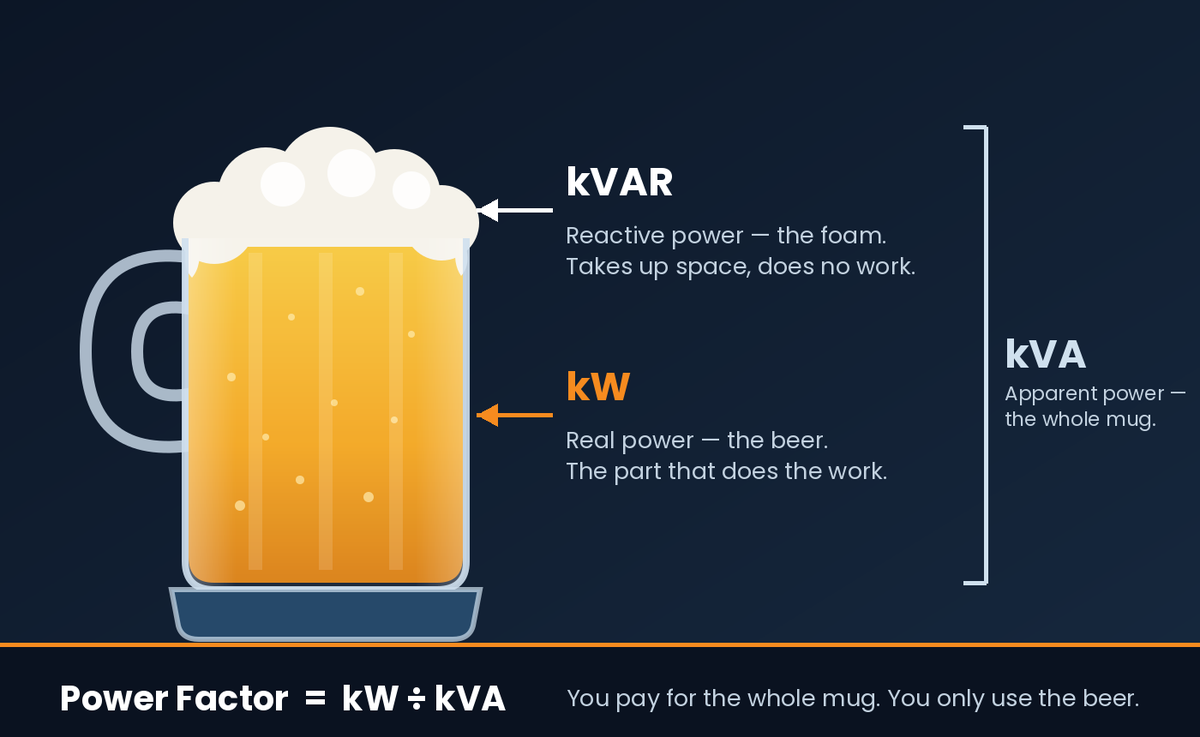
The beer is real power — kW — the power that runs your motors and production equipment. The foam is reactive power (kVAR): magnetizing current that inductive equipment needs, but that does no useful work. The whole mug is apparent power (kVA) — and that's what the utility has to deliver.
Power factor is the ratio of real to apparent power — kW ÷ kVA — the cosine of the phase angle (cos φ) between voltage and current. The three quantities form a right triangle: kVA² = kW² + kVAR². At 0.80 power factor, a facility draws 25% more current than its real load requires — and the utility sometimes sizes, meters, and bills for that current, whether through kVA demand billing, kVARh charges, or a penalty adjustment applied to kW demand.
Correction capacitors supply leading reactive current that cancels the inductive magnetizing current of motors and transformers at the point of use. The reactive power then circulates locally between capacitor and load instead of being carried through the utility's — and your own — distribution system: line current drops, I²R losses fall, and transformer and switchgear capacity is recovered. Sized to the measured load, correction typically targets 0.95–0.97 — high enough to clear the tariff threshold without overcorrecting. The kW demand and kWh usage will not change; however, the charges and the kVA will be reduced!
Corrective equipment — built for industrial environments
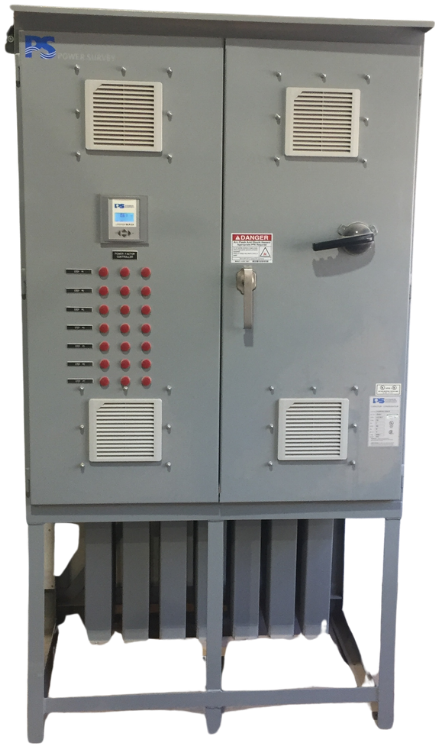
Off-the-shelf commercial capacitor banks routinely fail early in industrial plants — high ambient temperatures, conductive dust, vibration, and harmonic-rich loads are outside what catalog equipment is built for. RMEM specializes in designing and specifying heavy-duty correction equipment rated for the environment it will actually live in: enclosure ratings matched to the location, thermal management for high ambient conditions, contactors and protection selected for capacitor switching duty, and de-tuned reactors where harmonics are present. Every bank is engineered to the measured load and site conditions — and every installation includes 12 months of performance and savings reporting.
Frequently asked questions
What is a power factor penalty?
A charge utilities apply when a facility's power factor falls below the tariff threshold — sometimes explicit, often hidden in kVA demand billing or adjustment formulas.
How fast does power factor correction pay back?
RMEM power factor projects typically pay back in 6 to 24 months, with equipment life over 10 years.
What power factor do utilities require?
Commonly 90 to 95 percent, but it varies by tariff — and the penalty math varies even more. We verify both.